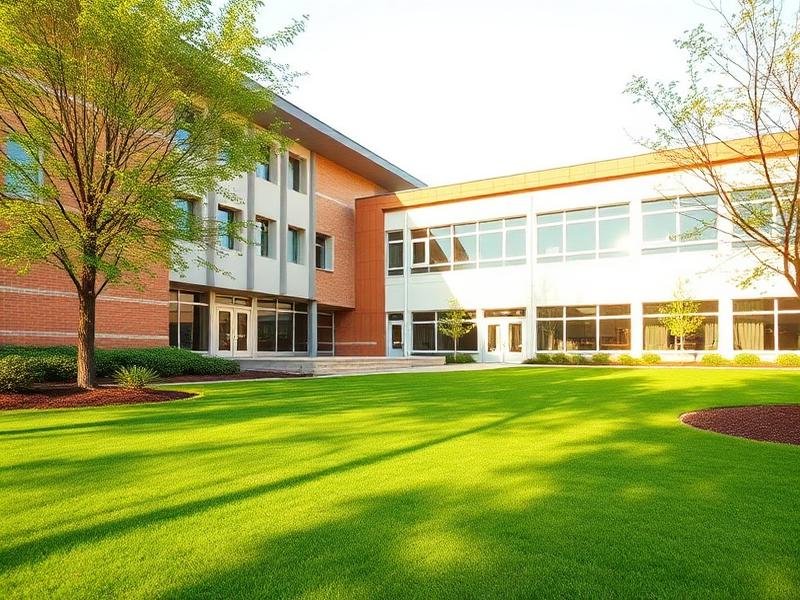
Stanford University is a private research university in Stanford, California, founded in 1885 by Leland and Jane Stanford and opened to students in 1891. It sits in the heart of Silicon Valley, a few minutes from the headquarters of several major technology companies, and enrolls roughly 7,500 undergraduates and more than 9,000 graduate students across seven schools. This guide focuses mainly on Stanford’s undergraduate program and draws on the university’s own admissions, registrar and financial aid pages for the curriculum, the qualification earned, the language of instruction, the age range, the fees and the other details prospective students look for first.
Stanford’s undergraduate curriculum combines a chosen major with a set of university-wide General Education Requirements designed to expose every student to a broad range of thinking before they specialize. The centerpiece of this system is Ways of Thinking, Ways of Doing, known informally as Ways, which requires eleven courses spread across eight thinking categories, taken at any point during a student’s undergraduate years. Alongside Ways, students complete a Civic, Liberal, and Global Education requirement, a Writing and Rhetoric requirement delivered in three stages, including a Writing in the Major course tied to each student’s chosen field, and a one-year foreign language requirement, which can be fulfilled through study, testing out, or Stanford’s Structured Liberal Education residential program built around close reading of major works in philosophy, literature and the arts.
Stanford offers 66 major fields of undergraduate study, called majors rather than concentrations, spanning humanities, social sciences, natural sciences, engineering and interdisciplinary programs; engineering students can also design an individually structured major with faculty approval. A single bachelor’s degree requires a minimum of 180 units of coursework, with at least 135 of those units completed at Stanford itself, and students pursuing a concurrent Bachelor of Arts and Bachelor of Science must complete at least 225 units. Each major sets its own additional requirements on top of the university-wide General Education Requirements, typically including a Writing in the Major course and a capstone project or thesis.
Graduates of Stanford’s undergraduate program receive a Bachelor of Arts, Bachelor of Science, or, in a small number of interdisciplinary programs, a Bachelor of Arts and Sciences. Stanford’s seven schools, covering Humanities and Sciences, Engineering, Earth, Energy and Environmental Sciences, Education, Law, Medicine and the Graduate School of Business, confer a wide range of graduate and professional degrees, including the Master of Science, Master of Arts, Doctor of Philosophy, Juris Doctor, Doctor of Medicine and Master of Business Administration, each governed by its own department-level admissions process separate from undergraduate admissions.
Instruction throughout Stanford is conducted in English, and while Stanford’s admissions pages do not set out a single explicit minimum English proficiency score in the way some universities do, international applicants whose education was not conducted primarily in English are generally expected to demonstrate English proficiency as part of a complete application, and Stanford’s foreign language requirement for undergraduates does not exempt students from taking coursework and communicating in English throughout their degree.
Stanford sets no explicit minimum or maximum age for undergraduate admission. Entry depends on academic achievement, intellectual curiosity and demonstrated engagement with community and learning, rather than age, and Stanford’s own admissions materials describe looking for students who are “curious and questioning” and who commit deeply to opportunities for growth, without reference to an age threshold. In practice, the great majority of entering students are recent secondary school graduates applying in their final year of high school, but Stanford does not publish a stated policy excluding older applicants.
Stanford’s undergraduate admissions process is highly selective and holistic, weighing academic rigor, class rank, grade point average, test scores, essays and recommendations, all rated “Very Important” by the university’s own admissions criteria, alongside extracurricular achievement, talent and personal character. Applicants use the Common Application. Stanford reinstated a standardized testing requirement, the SAT or ACT, beginning with the Class of 2030, the first cohort to apply for Fall 2026 entry, ending several years of test-optional admissions introduced during the pandemic. Applicants choose between Restrictive Early Action, due November 1 with a decision released around December 15, and Regular Decision, due January 2 with a decision around April 1; Restrictive Early Action is non-binding but limits an applicant to only one private university’s early program, while allowing simultaneous applications to public and international institutions. For the Class of 2029, the last class admitted before the testing requirement returned, Stanford received 60,646 applications, its largest pool in university history, and admitted 2,302 students, an acceptance rate of about 3.8 percent, with a yield rate of roughly 80 percent among admitted students who chose to enroll. International students made up about 14 percent of that incoming class, representing roughly 70 countries.
Fees at Stanford are set annually by the Board of Trustees. For the 2026 to 2027 academic year, the Board decided to hold undergraduate tuition steady rather than increase it, keeping the rate at 67,731 dollars a year for families who pay in full, the same figure as the prior year. Standard room and board charges will rise by 3.5 percent for 2026 to 2027, based on rising operating costs, though Stanford had not finalized the exact dollar figure for the new academic year at the time newer public reporting was compiled, so applicants should check Stanford’s own tuition rates page for the confirmed total cost of attendance once published. Graduate tuition will rise by roughly 3 percent for 2026 to 2027, though for most graduate students tuition is covered in full by a fellowship or a research or teaching assistantship rather than paid out of pocket, and professional programs such as the Graduate School of Business, the School of Medicine and Stanford Law School set their own separate tuition rates.
As with several of its peer institutions, Stanford’s published tuition figure is not what most students end up paying. Stanford’s undergraduate admissions process is need-blind for U.S. applicants, and the university states it meets full demonstrated financial need for every admitted student, domestic or international, entirely through scholarships rather than loans. Under Stanford’s current policy, families with an annual income below 150,000 dollars and assets typical for that income level pay no tuition at all, and families earning below 100,000 dollars a year pay no tuition, room or board, receiving what amounts to a fully funded education. Families in the 100,000 to 150,000 dollar income band see their parent contribution capped at no more than 25,000 dollars a year, on a sliding scale down to zero. Stanford also excludes home equity from its need calculations, a detail that meaningfully benefits homeowner families in expensive housing markets such as coastal California. Almost half of Stanford undergraduates receive need-based financial aid, with the average need-based scholarship in the current freshman class exceeding 70,000 dollars, and roughly 86 percent of a recent graduating class left Stanford with no student debt at all.
Key school information at a glance:
- Type: private research university, founded 1885, located in Stanford, California, in Silicon Valley
- Structure: seven schools, including Humanities and Sciences, Engineering, Law, Medicine, Education, and the Graduate School of Business
- Qualifications: Bachelor of Arts, Bachelor of Science or Bachelor of Arts and Sciences across 66 undergraduate majors; Master’s, Ph.D. and professional degrees such as the J.D., M.D. and M.B.A. at the graduate schools
- Language of instruction: English; international applicants are generally expected to demonstrate proficiency as part of a complete application
- Age range: none specified; admission is based on academic achievement rather than age
- Undergraduate tuition: 67,731 dollars a year for 2026 to 2027, held flat from the prior year; room and board rising 3.5 percent
- Financial aid: need-blind for U.S. applicants; families earning under 150,000 dollars pay no tuition, and those under 100,000 dollars pay no tuition, room or board
- Acceptance rate: about 3.8 percent for the Class of 2029, with a yield rate of roughly 80 percent and international students making up about 14 percent of the class
- Application: the Common Application; Restrictive Early Action due November 1, Regular Decision due January 2; SAT or ACT required beginning with the Class of 2030
- Source: figures drawn from Stanford University’s official news releases, Student Services, Financial Aid Office and Office of Undergraduate Admission
Because Stanford’s tuition, fees, financial aid thresholds and testing policy have all changed in recent cycles, and because full admissions statistics for a given class are only confirmed months after decisions go out, applicants should check Stanford’s official admissions and financial aid pages for the current figures before applying or budgeting.